2023. 3. 7. 21:24ㆍMachine Learning
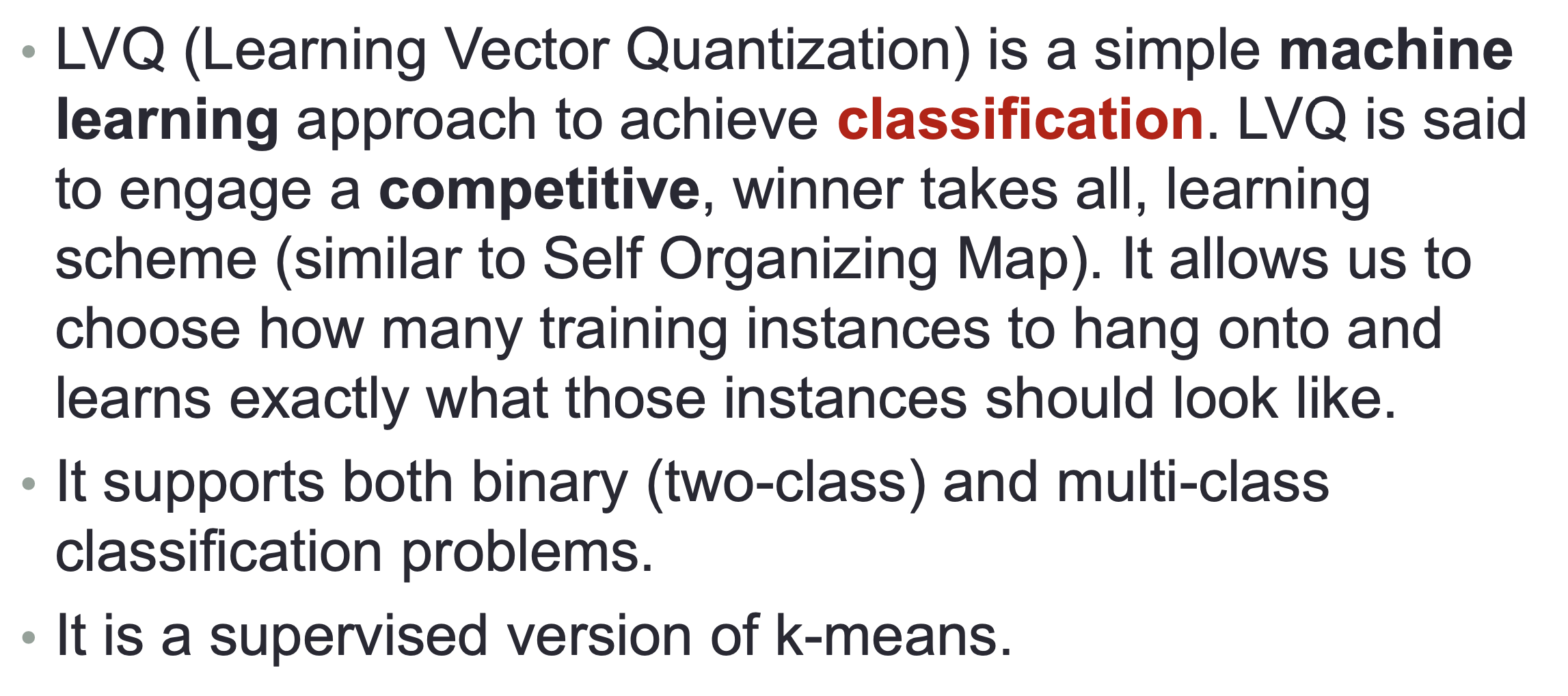
KNN (K-Nearest Neighbors) and LVQ (Learning Vector Quantization) are both popular machine learning algorithms for classification tasks, but they differ in their approach and methodology.
KNN is a non-parametric and lazy learning algorithm, which means that it does not make any assumptions about the underlying distribution of the data and does not learn a model from the training data. Instead, KNN works by comparing the distances between the input data point and its k nearest neighbors in the training data, and then classifying the data point based on the majority class of the nearest neighbors. KNN is simple to implement and can be effective in many cases, but it can be slow and memory-intensive for large datasets, and it does not work well with high-dimensional data.
LVQ, on the other hand, is a supervised learning algorithm that learns a set of prototype vectors (or codebook vectors) to represent the different classes in the data. The algorithm iteratively updates the prototypes to minimize the classification error on the training data. LVQ can be thought of as a hybrid between a clustering algorithm (which groups similar data points together) and a neural network (which learns weights to map input features to output classes). LVQ is often faster and more memory-efficient than KNN, and it can work well with high-dimensional data, but it requires more tuning and parameter selection, and it may not be as robust to noisy or overlapping classes.
In summary, KNN is a simple and flexible algorithm that can be effective for many classification tasks, especially for small to medium-sized datasets, while LVQ is a more structured and specialized algorithm that can be faster and more efficient for larger datasets or high-dimensional data, but may require more fine-tuning and careful selection of hyperparameters.
'Machine Learning' 카테고리의 다른 글
| What is "Curse of dimensionality" (0) | 2023.03.08 |
|---|---|
| What is PCA? (0) | 2023.03.07 |
| Practice of MLP question (0) | 2023.03.07 |
| What is ROC? (0) | 2023.03.07 |
| What is trade-off between sensitivity (or TPR) and specificity (1-FPR)? (0) | 2023.03.07 |